Simplified version
Product design case study

Prompt Studio

Turning scattered prompt work into one product workflow.

Prompt Studio — the prompt library, with a version live in production
The bigger picture

One place to trace, evaluate, and simulate every decision your agents make.

Netra helps the teams building them see what their agent is doing, catch problems, and make it reliable.

Prompt Studio is one part of Netra — the part I worked on.

Placeholder
The feature

So — what is Prompt Studio?

A single place for developers to create, run, compare, test and release the prompts behind their AI agents — instead of writing in one tool, testing in another, and keeping track of versions by hand.

The Prompt Studio workspace — writing a prompt with variables
A prompt being run inside Prompt Studio, with its result
My role & the users

What I worked on — and who for.

My focus wasn’t the individual screens. It was understanding the workflow, finding where people got stuck, and connecting it all up — so creating, testing, comparing, releasing and reverting a prompt feels like one flow instead of six.

Developers building agentsAI engineers iterating on promptsReviewers near production

I came in when the product was already underway, and shaped Prompt Studio as we worked out the wider prompt-management flow.

Before Prompt Studio

The scattered, disconnected journey.

The traditional, scattered prompt-management workflow — steps, where it breaks, and the impact

The same thing kept coming up when I talked to people across roles — our product engineers and the developers building agents: one prompt, dragged through a dozen tools, breaking at every step.

The solution starts here

Where the solution came from.

Once I understood where the journey kept breaking and where the other tools came up short, the direction got pretty clear. So instead of copying how prompt tools already look, I started from a simpler question — what does a prompt actually need across its whole life? — and built the workflow around that. Everything below is that, stage by stage.

Create
write it
→
Run
quick check
→
Compare
best version
→
Stress-test
best config, at scale
→
Publish
to production
→
Revert
if it breaks
Create & Run

Keep creation in the flow.

Write a first prompt from a plain description and refine it with AI right where you test it. Drafts auto-save, and a quick Run shows you the output before you commit to a full evaluation.

describe → generate → refine → run
Generate and refine a prompt with AI, inside the platform
Compare

Compare to find the best prompt.

Line up candidate prompts side by side and see their results together — so picking the best one is something you look at, not something you have to remember.

What changed — picking a version went from a gut call to something you can just see.
Two prompt versions compared side by side with their results
Stress-test

Prove it holds up, at scale.

Run the prompt across models and repeated executions to find the best setup and see how reliable it is. Starting a run stays simple; the results open with the overall outcome first, then let you drill into models, evaluators and individual runs.
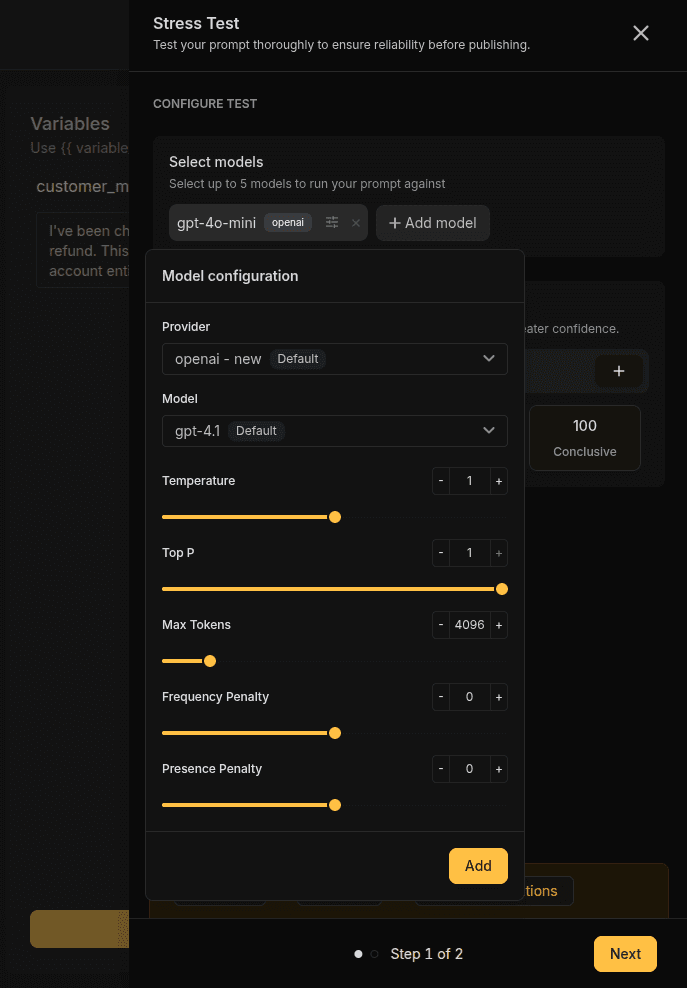
choose model → runs → evaluators → run → review
What changed — you could trust a prompt at a glance, or go digging the moment a result felt wrong.
Stress-test setup — choose models, runs and evaluators
Publish

Publishing is a decision, not a save.

Draft → Published → Production. A draft you can change however you want; publishing locks in a fixed, read-only version; production just points at whichever one is actually live.
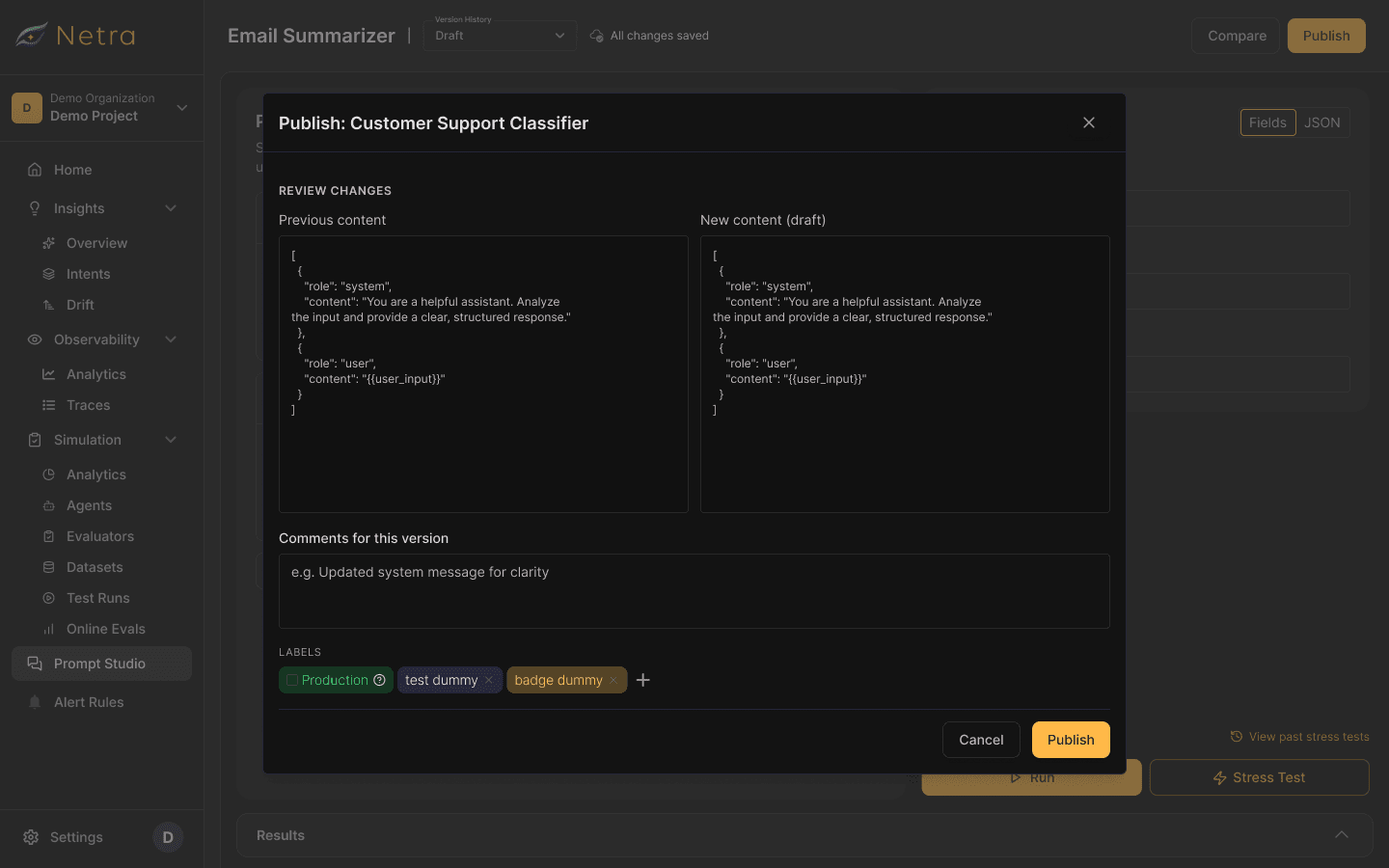
Publishing a fixed version to production
Revert

A safe way back.

Every published version sticks around, so production can drop back to an earlier one the moment something breaks — which closes the loop from create all the way to recover.

Version history — every published version kept for rollback
Contribution & impact

Not a prompt editor — a workflow.

01
Reframed the problem
Turned “prompt creation” into a full lifecycle — the backbone the rest of the product is built on.
02
Separated Draft, Published & Production
Developers could experiment all they wanted without ever putting what’s live at risk.
03
Brought creation in-platform — generate & refine with AI
People stopped bouncing out to other tools to write prompts and just stayed put.
04
Simplified testing, made results progressive
Teams could size up reliability at a glance instead of drowning in metrics.
05
Designed one connected workflow — failures included
That scattered before-journey turned into one place — draft to production, without the guesswork.
Still in development. Thanks for your time.

Create a free website with Framer, the website builder loved by startups, designers and agencies.